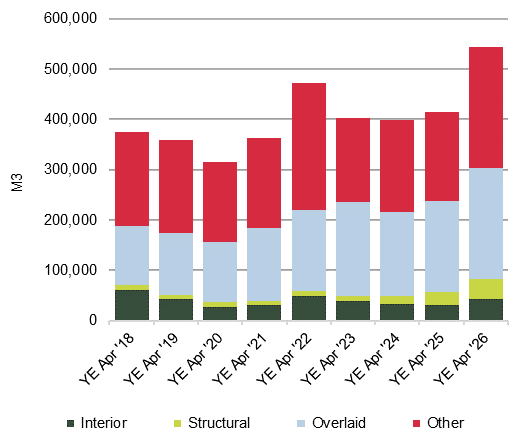
Australia’s plywood imports rose 31.1% to total a record 544,156 m3 year-ended April 2026. Underscoring the significance of the increase, the annual value of imports also bested the previous record, lifting 13.3% to AUDFob477.1 million.
Importantly, these imports do not include plywood-backed material like that used for flooring, wafer, batten, and other board products that are mingled into traditional plywood definitions. They come at a time when the housing market is recovering but has yet to reach the heights of the last boom, in 2022.
Australian Plywood Imports by Grade: YE Apr ’18 – YE Apr ‘26 (m3)
Source: ABS and IndustryEdge
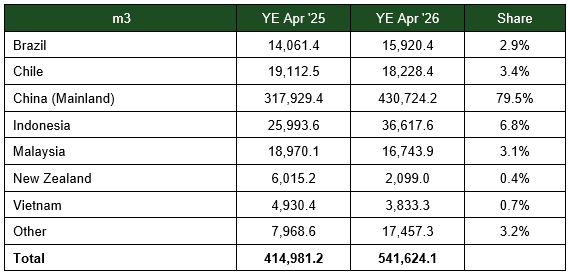
The table below shows annual Plywood imports for the year-ended April 2026.

Source: ABS and IndustryEdge
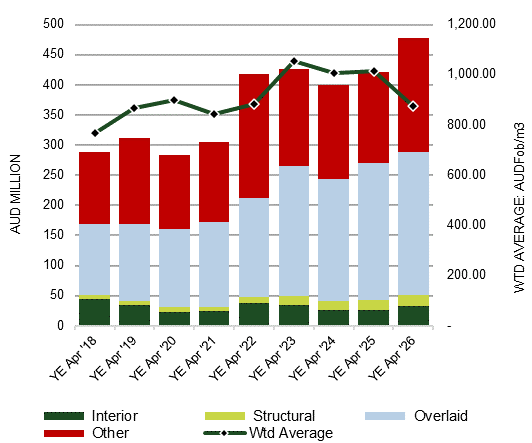
As the chart below demonstrates, the value of plywood imports has largely tracked volumes, with some notable differences from 2023 to 2025 when weighted average prices were higher than the most recent year.
Value of Australian Plywood Imports: YE Apr ’18 – YE Apr ‘26 (AUDM & AUDFob/m3)
Source: ABS and IndustryEdge
Perhaps of greatest relevance is that the weighted average price for the year-ended April 2026 (the black line) was AUDFob877/m3, just AUD6/m3 below the weighted average price four years earlier when the previous records were set.
The price-based parameters for increasing imports of plywood may be written into this data. That is, at some point around or below AUDFob900/m3, plywood imports appear to have strong growth credentials.
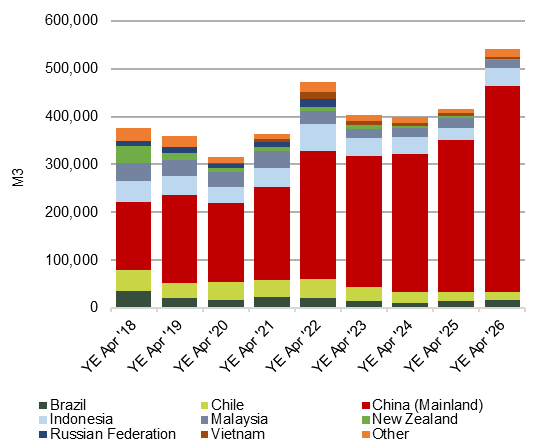
When it comes to countries of origin, there are few surprises in Australia’s plywood imports. Supplies from China dominate, delivering almost 80% of the total year-ended April 2026, with Indonesia landing 6.8% of the total and Chile 3.4%.
Australian Plywood Imports by Country: YE Apr ’18 – YE Apr ‘26 (m3)
Source: ABS and IndustryEdge
Year-ended April 2026, Australia imported plywood, wood panels and engineered wood products valued at an incredible AUD1.219 billion, on a free-on-board basis. Not landed or Cif (add the freight cost), and not delivered or FIS (add the delivery, handling, gross margins and so on.
Of that AUD1.219 billion, plywood accounted for 39.1%, falling just short of the half billion-dollar marker. What is certain is that historic point will be reached at some point later this year. If, that is, it has not already been exceeded.