As part of FWPA’s data analysis and our ongoing campaign to highlight the benefits of using timber, we estimated that a single hectare of softwood plantation can produce enough wood products to build four houses, manufacture around 700 shipping pallets, and supply more than 100 metres of fencing, while still leaving material available for landscaping products, appearance-grade timber, and renewable-energy sawdust.
These figures help illustrate the significant value that can be generated from a relatively small area of sustainably managed plantation forest. They also demonstrate how a single harvested resource can be transformed into a wide range of products that support housing, manufacturing, construction, and renewable energy. This article explains how these estimates were calculated, the assumptions underpinning the analysis, and what they reveal about the efficiency and versatility of Australia’s softwood plantation resource.
The Starting Point: 125 m³ of Wood Product per Hectare
The estimate begins with two numbers from FWPA-ABARES research collaborations. First, the average sawlog yield across softwood plantations in the National Plantation Inventory (NPI) regions1 is about 300 m³ of sawlog per hectare. Second, not all of that log converts into usable sawnwood. Some is lost to processing, offcuts and residue. The recovery rate is the ratio of sawnwood production divided by sawn log harvested. It has averaged 41.8% over 2010–2025.
Multiplying the two gives the headline figure: 300 m³ sawlog/ha × 41.8% recovery rate ≈ 125 m³ of wood product per hectare
That 125 m³ is then split across end-uses using the average product mix from FWPA’s monthly softwood sales volume data. This is the same series that tracks how much of Australia’s softwood goes to structural timber, packaging, and other outdoor and appearance products.
Structural timber: enough to build four houses
Structural timber used for framing detached houses accounted for an average of 50.6% of total softwood sales volume between 2010 and 2025. FWPA’s residential construction research found that a typical detached house requires approximately 14.58 m³ of structural timber. Based on these findings, the volume of structural timber produced from a single hectare of softwood plantation is sufficient to frame and build around four average detached houses.

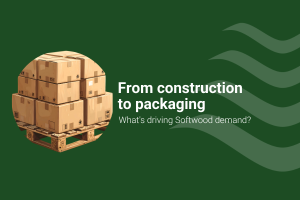
The output is also enough to make 700 Pallets
Packaging timber products, including both green and dry timber used in the manufacture of pallets, crates and other transport packaging, accounted for an average of 22.4% of total softwood sales volume over the past five years. These products play a critical role in Australia’s freight, logistics and export supply chains, providing durable and cost-effective solutions for moving goods across the country and overseas.
Based on this share of softwood production, a single hectare of plantation forest can generate enough packaging timber to manufacture around 700 standard shipping pallets, highlighting the significant contribution of plantation-grown timber beyond housing and construction. This demonstrates how one renewable resource supports multiple sectors of the economy, from residential building through to manufacturing, transport and trade.

100+ Metres of Fencing and Other Products
The remaining softwood output of around 30% covers fencing, outdoor and landscaping products, appearance-grade timber, and sawdust used for renewable energy. The fencing component specifically has averaged about 3.5% of production. Using an industry conversion of 25 lineal metres of fencing per m³ of timber: > 4.4 m³ × 25 m/m³ ≈ 109 metres, i.e. “100+ metres” of fencing per hectare. The remaining ~23.5% of output not captured in the fencing estimate goes to landscaping products, appearance timber and sawdust for renewable energy.

The table below summarises the estimates for each product category and the corresponding outputs that can be generated from a single hectare of softwood plantation.
| Parameter | Data | Estimation | Sources |
|---|---|---|---|
| Wood products per hectare of softwood plantation | Softwood sawn log harvested; softwood sawn wood production; saw log yield per hectare | The ratio between softwood sawn wood production and sawn log harvested reflects the recovery rate of wood products at actual size. The average ratio for 2010–2025 was 41.8%. The average saw log yield per hectare is based on softwood plantations in the National Plantation Inventory (NPI) regions and tree species. On average, the yield is 300 m³ per hectare | Australian Forest and Wood Product Statistics (AFWPS) 2026: FWPA–ABARES Research Collaboration. Australian Plantation Statistics and Log Availability 2021 (Appendix C: Regional Yield Table): FWPA–ABARES Research Collaboration. |
| Four houses per hectare of softwood plantation | FWPA monthly softwood sales volume data; average structural timber required to build standard detached houses | The softwood sales volume data categorises production of structural timber products, mainly for dwelling construction. The average proportion for 2010–2025 was 50.6%. An FWPA study in 2017–18 showed the average timber required to build an average house was 14.58 m³. | The FWPA Industry Data: Public Information Portal and/or Data Dashboard Portal. The FWPA study of average required timber to build a standard house in 2017–18. |
| Pallets per hectare of softwood plantation | Average packaging products in the FWPA monthly softwood sales volume data; timber required per standard ISO pallet | The proportion of packaging products over the last five years was 22.4%. Timber required per m³ to make a pallet was estimated at 0.04 m³. | The FWPA Industry Data: Public Information Portal and/or Data Dashboard Portal. Converter for timber required to make a pallet. |
| Other products (fencing, landscaping, etc.) per hectare | Average proportion of products in the FWPA monthly softwood sales volume data | The proportion for fencing and landscaping was around 3.5%. For fencing, the average conversion is 25 lineal metres per m³. | The FWPA Industry Data: Public Information Portal and/or Data Dashboard Portal. Timber product conversion table. |